
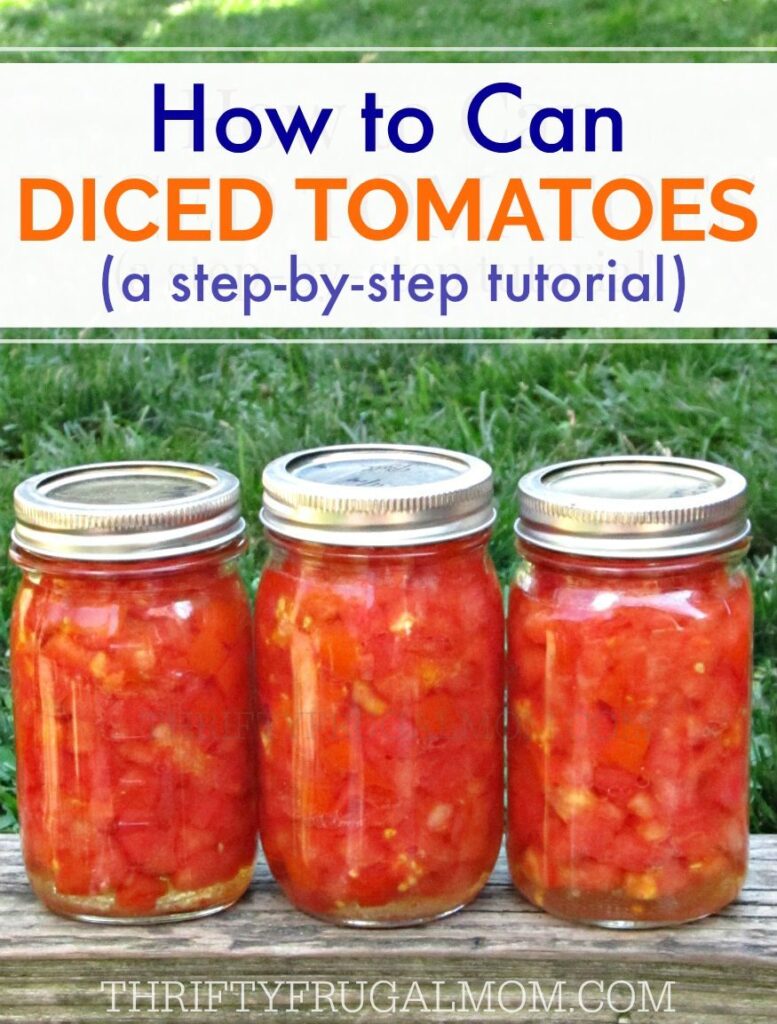
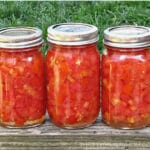
The absolute easiest way to can tomatoes! This step-by-step photo tutorial will show you how to can tomatoes in no time. No peeling, no coring- just cut out the stem and dice them up. It’s super easy, plus if you grow your own tomatoes, it’s a big money saver too!
There are affiliate links in this post. As an Amazon Associate, I earn from qualifying purchases. Please read my full disclosure policy.
I started canning diced tomatoes several years ago after having an “aha moment” one evening while preparing dinner. As I was opening a can of diced tomatoes that I needed for the recipe I was making, I suddenly wondered why in the world I never tried canning them myself. I mean how hard could it be?
I grew up helping my mom can tomato juice and tomato chunks. And every year since we’ve been married, I’ve canned tomato juice as well as things like salsa and marinara sauce, so I was quite familiar with the process of canning tomatoes.
I decided to give it a try, and it worked like a charm! It was not only super simple, it has also saved me from needing to buy diced tomatoes from the store.
How do you can tomatoes? Let me help you learn the process!
Supplies for Canning Tomatoes
- Tomatoes
- Salt (optional, but recommended for best flavor)
- Citric Acid or bottled lemon juice or
- Dishpan or containers to put the tomatoes in
- Knife (This one is my favorite for slicing tomatoes!)
- Cutting board (The groove on this one is awesome because it catches the juice, creating less mess.)
- Vidalia Chop Wizard (Not a necessity, but you can dice the tomatoes in about half the time if you use it.)
– This gadget is also awesome for dicing tomatoes, onions, and peppers for salsa and potatoes and carrots for soups. - Wide Mouth Funnel
- Damp cloth to wipe jar rims
- Small pan to boil jar lids in
- Fork or Lid Wand
- Water Bath Canner (or this Canning Rack may work depending on what size pot you already own)
- Canning jars with lids and rings
- Jar lifter
- Old towels or rags to set the hot jars on
How to Can Diced Tomatoes- a step-by-step tutorial
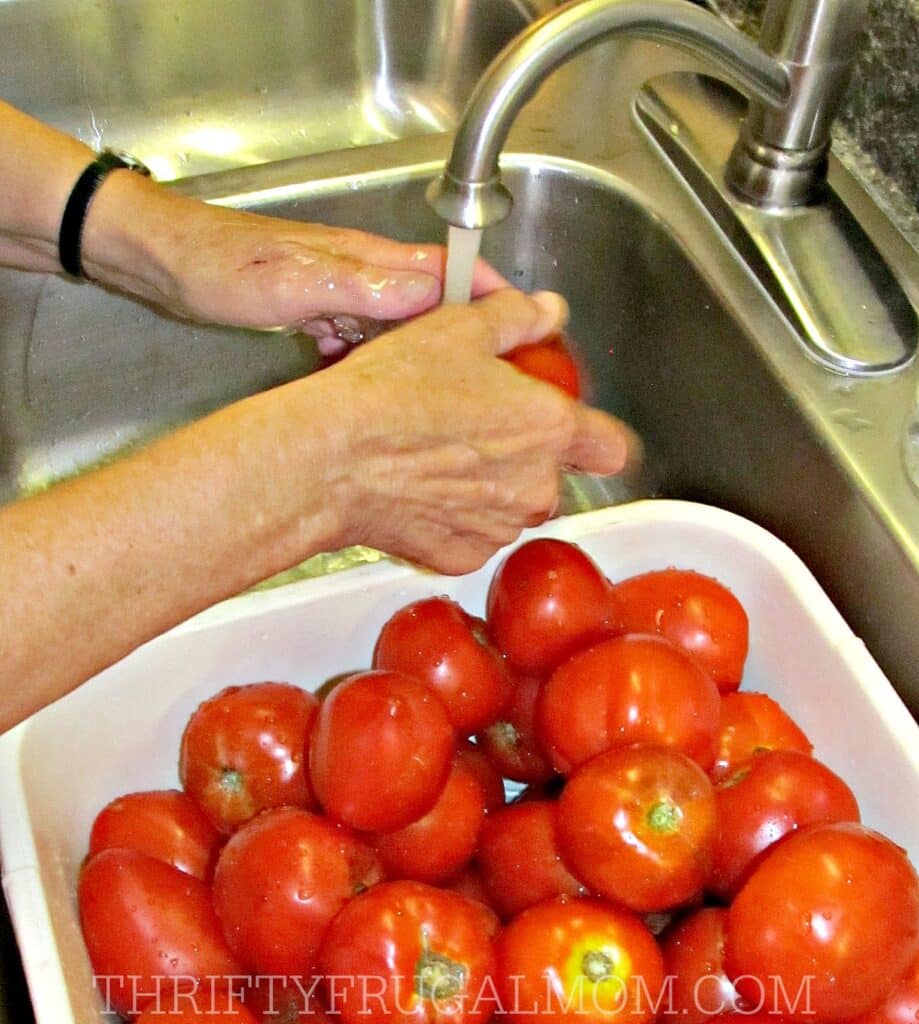
1. Wash tomatoes thoroughly.
Cut out the stem and any defects or blemishes.
Some people also peel the tomatoes, but I never do, and we honestly have not noticed the peelings at all and I’m even funny about textures like that in food.
I figure, why bother with the extra step? Plus it’s a bit healthier too!
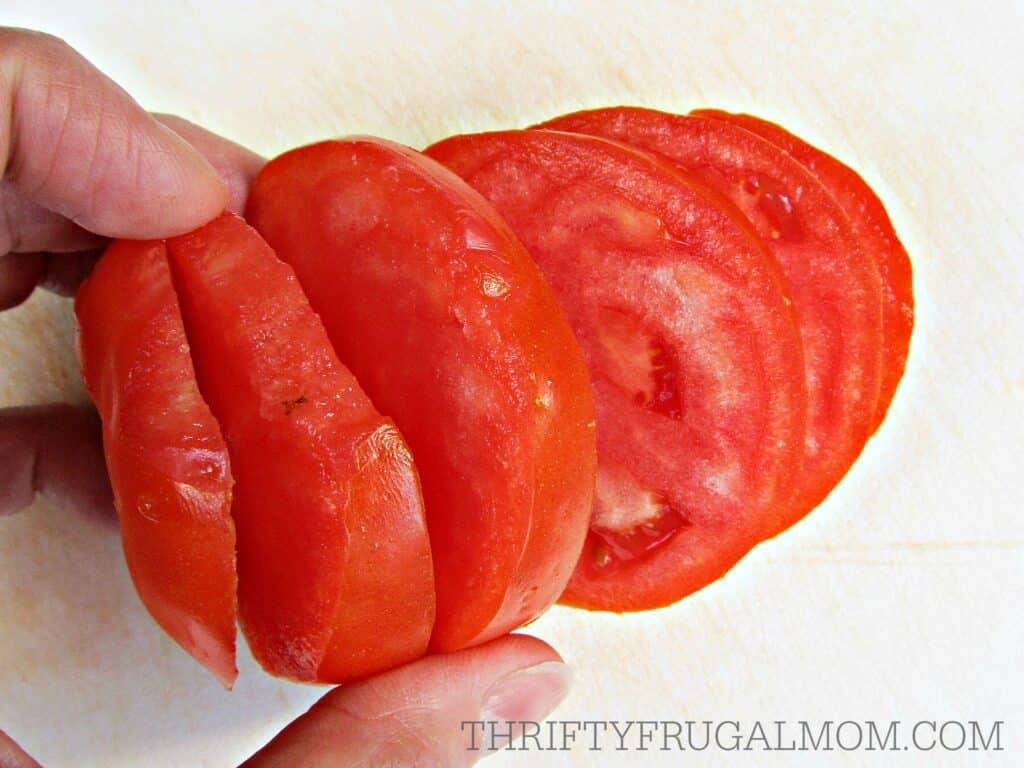
2. Cut up the tomatoes.
Slice tomatoes into about ½-inch thick slices, then dice them into whatever size you want. I love using the large dicing side of my Vidalia Chop Wizard for this!
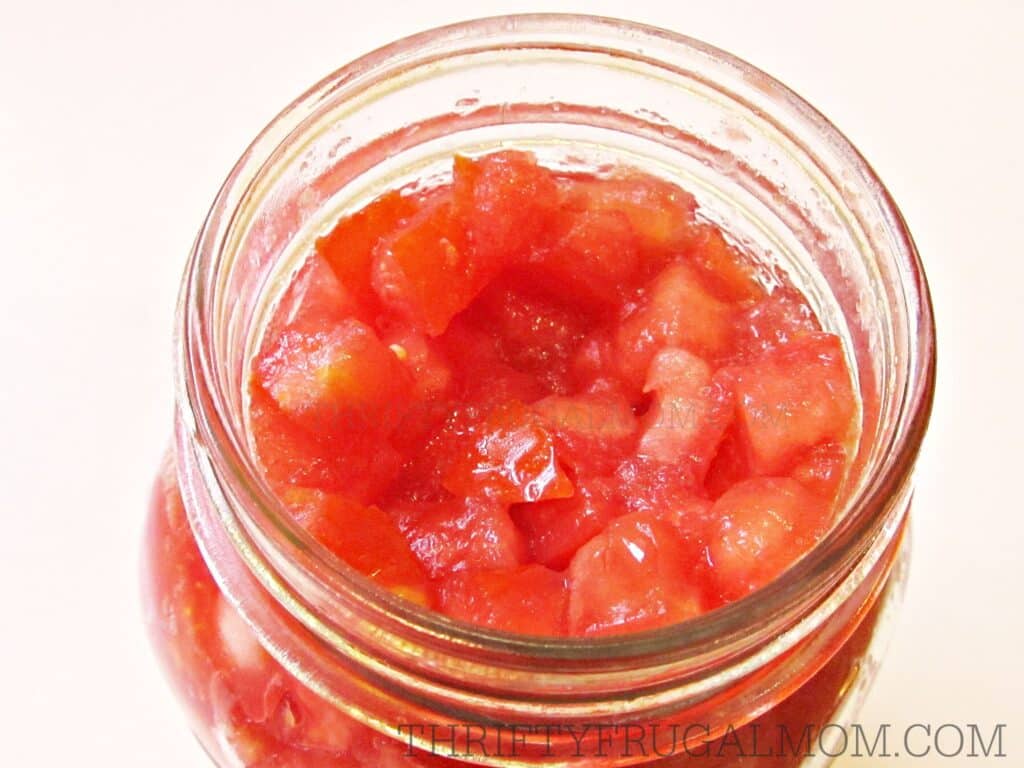
3. Place diced tomatoes into a clean canning jar.
A funnel makes this super easy. Gently shake the jar to settle the tomatoes so that you can fill it completely.
The tomatoes should be packed tightly to produce enough juice. It won’t hurt if you press down on them a bit to get the jar packed full- in fact, this is probably going to be necessary.
The jar should be full to the base of the neck.
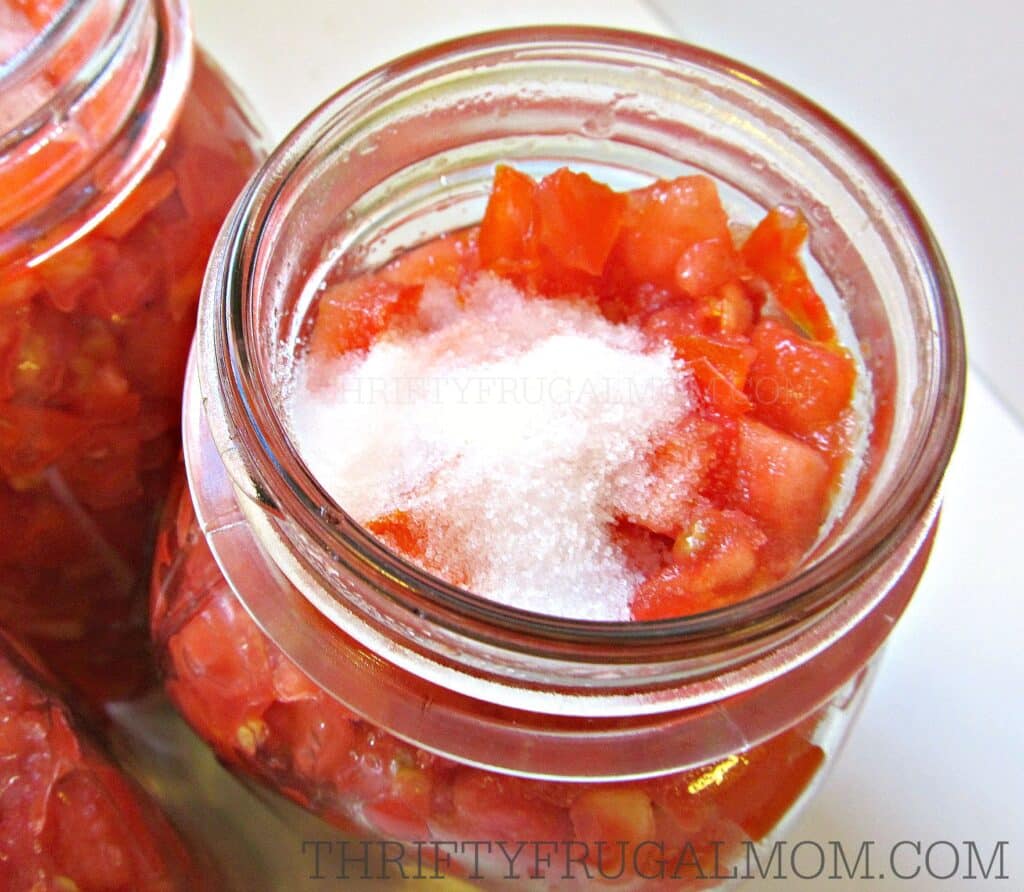
4. Add salt and Citric Acid or bottled Lemon Juice.
For the salt, use ½ tsp. per pint and 1 tsp. per quart. You do not need to add salt when canning tomatoes, but I recommend it because I think it helps enhance the flavor.
Add citric acid (1/4 tsp. per pint or 1/2 tsp. per quart) or bottled lemon juice (1 Tbsp. per pint or 2 Tbsp. per quart) to each jar to create a safe acidity level.
Once the salt and citric acid/lemon juice are added to the tomatoes, wipe the rim of each canning jar with a clean, damp cloth to remove any tomato residue. (If there is even a slight bit of tomato juice on it, it may not allow it to seal properly.)
I updated the original post to include the instructions to add lemon juice or citic acid after several readers commented and said that to be safe, you really should add it.
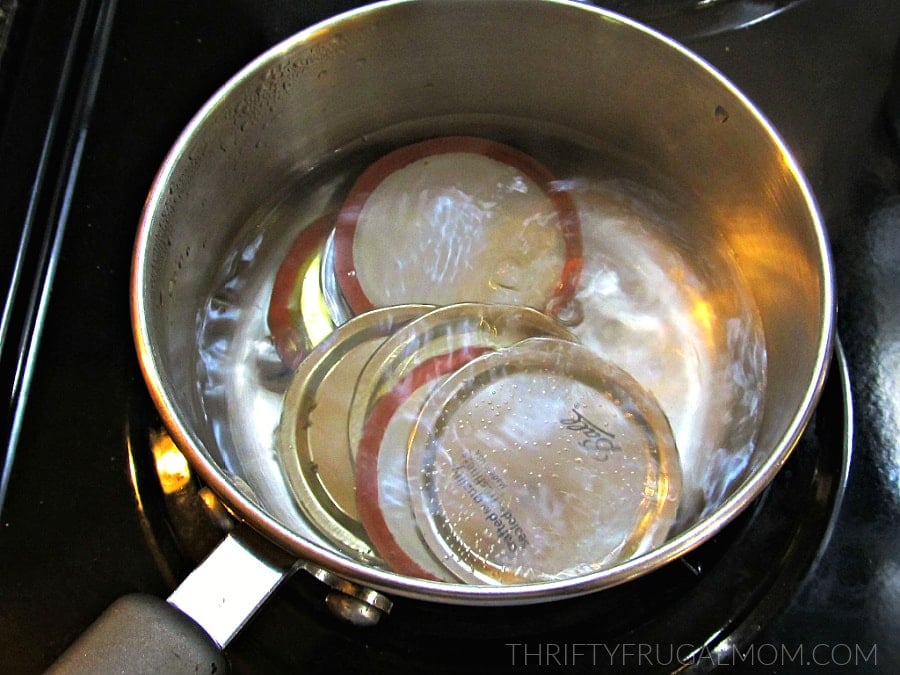
5. Prepare the canning lids. (This may be optional!)
Update: Some canning lid manufacturers now say that it’s not necessary to preheat the lids. So before doing this, check the instructions that came with the lids you are using.
Once you have 7 jars filled, place 7 metal canning lids in a small pan. Cover with water; bring to a boil.
When the water boils, use a fork or lid wand to lift the jar lids out of the water and place them on the jars. Be careful not to burn yourself!
Secure each lid with a jar band/ring.
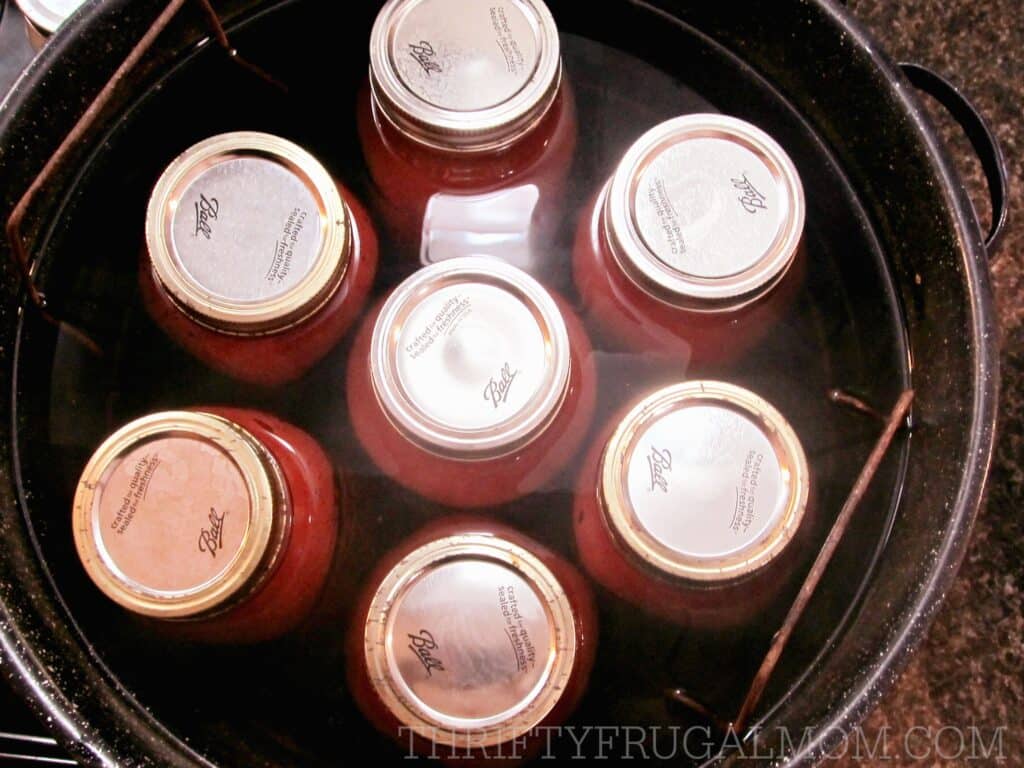
6. Place the filled jars of tomatoes in the canner.
Once jars are full and have the rings and lids on them, place them in the canner.
Then add hot water to the canner, enough to cover the jars by 1 to 2 inches. Cover the canner with a lid. Turn the burner to medium-high heat.
Once the water starts to boil, reduce the heat slightly and process for 45 minutes, making sure the water is boiling gently and steadily the whole time. (You may need to adjust the heat to keep the boil going nicely, but as long as it is boiling, you are fine.)
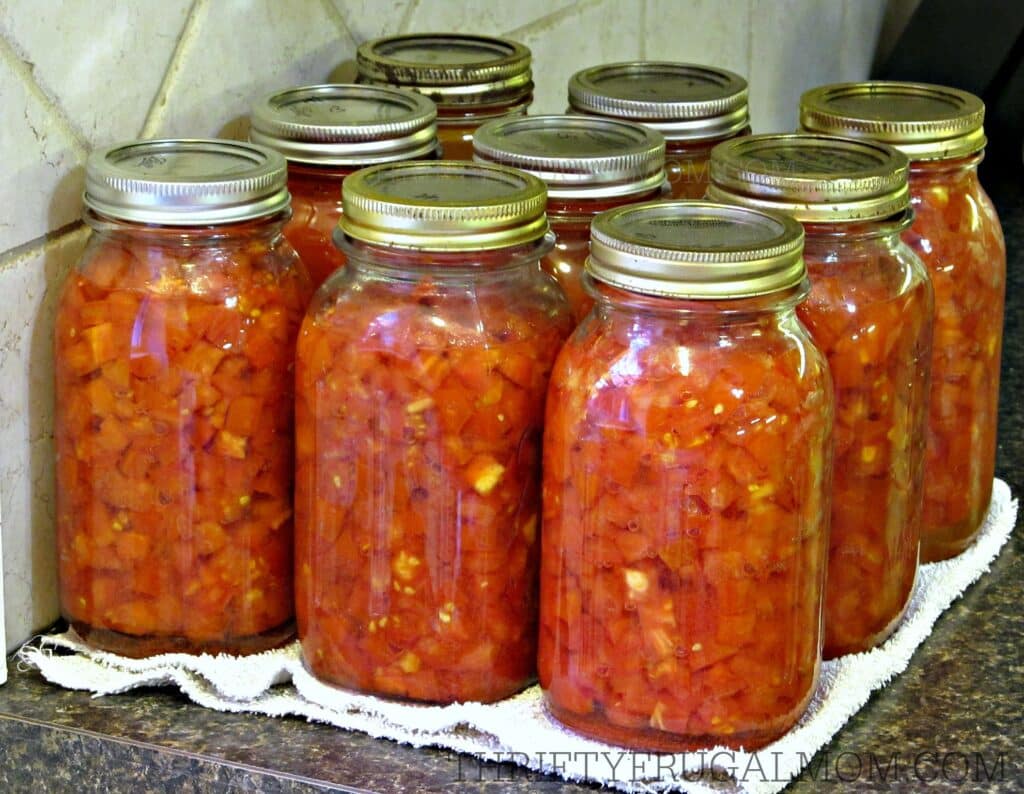
7. Remove the jars of canned tomatoes.
After processing the canned tomatoes for 45 minutes, turn the burner off.
Remove jars using a jar lifter- you may want to have a dishrag in your other hand to catch any hot water that drips from the jars as you remove them- and place on an old towel, blanket or another padded surface. (This is to protect your counter from the super hot jars.)
Allow at least a little bit of airspace around each jar, making sure the jars are not close enough to touch. Do not move until the jars are completely cool.
Jars should seal as they cool, and you will typically hear a snap or pinging sound as the vacuum seal forms. The lids will be slightly concave when sealed.
To test the seal, once the jar has totally cooled, you can lightly tap the center of the cooled jar lid. If it is firm and does not move, it should be sealed. If it pushes in, it didn’t seal properly. You can still use unsealed jars, just put them in the refrigerator and use them as soon as possible.
After the jars are completely cool, you can remove the rings. Jars should be wiped clean before storing them.
Enjoy!
HELPFUL TIP: 1 pint of canned diced tomatoes is equivalent to 1 (15 oz.) can of diced tomatoes.
Other canning recipes you might also enjoy:
How to Can Diced Tomatoes
Equipment
- Dishpan or containers to put the tomatoes in
- Knife
- Cutting board
- Vidalia Chop Wizard (Not a necessity, but you can dice the tomatoes in about half the time if you use it.)
- Wide Funnel
- Damp rag to wipe tops of jars
- Canner
- Canning jars with lids and rings
- Jar lifter
- Old towel, blanket or other padded surface to put hot jars on
Ingredients
- fresh tomatoes (approximately 2 3/4 lb. for 1 quart jar)
- salt (1 tsp. per quart or 1/2 tsp. per pint)
- bottled lemon juice or citric acid (see step 5)
Instructions
- Wash tomatoes thoroughly. Cut out the stem and any defects or blemishes. Some people also peel the tomatoes, but I never do and we honestly have not noticed the peelings at all- and I’m even funny about textures like that in food. I figure why bother with the extra step, plus it’s a bit healthier too!
- Slice tomatoes into about ½ inch thick slices, then dice them into whatever size you want. I love using the large dicing side of my Vidalia Chop Wizard for this!
- Place diced tomatoes into a clean canning jar- a funnel makes this super easy. Gently shake jar to settle tomatoes so that you can fill it completely. The tomatoes should be packed tightly in order to produce enough juice. It won't hurt if you press down on them a bit to get the jar packed full- in fact, this is probably going to be necessary. The jar should be full to the base of the neck.
- Add salt (½ tsp. per pint and 1 tsp. per quart)- optional but recommended for best flavor.
- Add citric acid (¼ tsp. per pint or ½ tsp. per qt) or bottled lemon juice (1 Tbsp. per pint or 2 Tbsp. per quart) to each jar of tomato juice to create a safe acidity level.
- Wipe rim of each jar with a damp cloth to remove any tomato residue that may be there. (If there is even a slight bit of tomato juice on it, it may not allow it to seal properly.)
- Update: Some canning lid manufacturers now say that it's not necessary to preheat the lids. So before doing this, check the instructions that came with the lids you are using. Once you have 7 jars filled, place 7 metal canning lids in a small pan. Cover with water; bring to a boil. Once the water boils, use a fork or lid lifter to lift the jar lids out of the water- be careful not to burn yourself!- and place them on the jars. Secure each lid with a jar band/ring. (Heating the lids softens the rubber, allowing for a better seal.)
- Place 7 jars in canner. Fill with enough hot water to cover the jars by 1 to 2 inches. Cover canner with a lid. Turn the burner on medium high heat. Once the water starts to boil, reduce heat slightly and process for 45 minutes, making sure the water is boiling gently and steadily the whole time. (You may need to adjust heat to keep the boil going nicely, but really, as long as it is boiling, you are fine.)
- After processing for 45 minutes, turn the burner off. Remove jars using jar lifter- you may want to have a dishrag in your other hand to catch any hot water that drips from the jars as you remove them- and place on an old towel, blanket or another padded surface. (This is to protect your counter from the super hot jars.) Allow at least a little bit of air space around each jar, making sure not to have jars close enough to touch. Do not move until jars are completely cool.
- Jars should seal as they cool and you will typically hear a snap or pinging sound as the vacuum seal forms. Lids will be slightly concave when sealed. To test the seal, once jar has totally cooled, lightly tap the center of the cooled jar lid. If it is firm and does not move, it should be sealed. If it pushes in, it didn’t seal properly. You can still use unsealed jars, just put them in the refrigerator and use them as soon as possible.
- After jars are completely cool, you can remove the rings. Jars should be wiped clean before storing them.


Penny Mann
What is the purpose of using lemon juice?
Lydia Beiler
The lemon juice’s acidity helps reach a pH level that prevents bacteria from growing in the canned tomatoes. Newer varieties of tomatoes especially are bred to be less acidic, but even with older varieties, it’s recommended as there is no way to tell if you have the proper pH level without testing it.
Leigha
Could you add additional items in with the tomatoes such as onion and basil to make diced tomatoes like in the store?
Lydia Beiler
Onions and basil should be fine, Leigha! You could also add peppers too if you are wanting more of a Rotel substitute.
Leslie Ryan
I’m new to growing my own fruits and veggies and canning. Are these to be stored in the refrigerator or at room temp? And how long will they last?
Lydia Beiler
Welcome to the world of growing your own produce and canning! It can all feel like a lot to learn but it’s a wonderful thing! Canning preserves food in a way that allows it to be stored at room temperature, usually for at least a year. Once the canned food is opened, it needs to be refrigerated like any other store-bought canned item.
Sandra
What a great recipe! My grandmother canned fruits and veggies every summer but I have never known how to do it. Your instructions are clear and easy to follow. Thanks!
Lydia Beiler
Thanks, Sandra! So fun that you had a grandmother that canned! And yes, canning can feel rather intimidating but it really is pretty easy for anyone to do.
Heather
So I dice tomatoes and leave them raw, and do I put them in cold or hot mason jars? And then boil the jars for 45mins?
Lydia Beiler
Yes, it’s raw tomatoes and you just use room temp mason jars and gently boil for 45 minutes. Hope that helps!
Julie
Hi! When adding salt and lemon juice, just leave them on top just as in the pictures? Or stir/mix in?
Thanks!
Lydia Beiler
Just add on top. As the jars heat up and “cook”, the liquid that the tomatoes produce actually kind of circulates and mixes the salt and lemon juice in nicely.
Emily
can i use apple cider vinegar instead
Lydia Beiler
No, only lemon juice will work. The only thing that can be substituted is 1/2 tsp. citric acid per quart of tomatoes.
Shelia
I just used your recipe and I’m all 7 jars, the liquid separated from the tomatoes. The liquid is on the bottom and the tomatoes on top. What did I do wrong?
Lydia Beiler
Sorry for the slow reply, Sheila! We are currently traveling and I haven’t been online very much. No worries! You didn’t do anything wrong. That is just how they do sometimes. I have the same thing happen. I think it happens more quickly if your jars aren’t super full but I don’t know if that is for sure the case. At any rate, they are fine to use.
Barbara
You can’t use fresh lemon juice either because the acidity is not right. Only commercially bottled lemon juice is recommended. Again USDA https://nchfp.uga.edu/